Cheam sits in the London Borough of Sutton but still reads as a Surrey village, and the plumbing and heating work here follows from that. WTS Plumbing & Heating Ltd has been looking after homes since 2008, and our head office is at Jayes Park Courtyard in Ockley, near Dorking. We are Gas Safe registered, we handle boilers, central heating, plumbing, drainage, air source heat pumps and air conditioning, and every job carries a 12-month warranty on parts and workmanship.
The village core around Park Lane, Malden Road, The Broadway and Park Road is a conservation area, one of fifteen in the borough. Around it sit thousands of interwar semis and detached houses that were built for solid fuel and converted to gas later. Those two facts shape almost every quote we write here, from where a flue can safely terminate to whether a combi will really hold up in a four-bedroom house on Northey Avenue. Call 01306 621 057 and we will talk it through first.
The houses in Cheam, and what they mean for your heating
Cheam is an interwar suburb wrapped around a small, genuinely old village. Sutton Council's own conservation area appraisal records that the village stayed chiefly agricultural until the early 20th century, then changed suddenly during the 1920s and early 1930s as Cheam Court Farm, Cheam Brewery and Cheam House were released for building, so that by 1939 most of the parish was built up. The 2021 Census shows what that left behind. In Cheam ward, of 4,088 households, 1,513 are detached, 891 semi-detached, 724 terraced and 742 are in purpose-built blocks of flats. Almost everything we are called to here was designed around a coal fire, not a boiler.
The oldest layer is small but it is real. Malden Road and Park Lane hold timber-framed and weatherboarded houses, including Whitehall at 1 Malden Road and the Rectory at 15 Malden Road, along with the listed cottages on Park Lane and Park Cottages on Ewell Road. White weatherboard, colour-washed brick and steeply pitched handmade clay tile roofs look lovely and behave awkwardly. Solid walls with no cavity, lath and lime plaster inside and a framed structure that must not be casually drilled all narrow the options for a flue terminal, a condensate run or an outdoor unit.
Then comes the Victorian and Edwardian layer: yellow London stock brick terraces and semis on the east side of Malden Road, Wildes Cottages on Ewell Road, and the late Victorian terrace on Jubilee Road with red brick below and render or pebbledash above. On those, expect chimney breasts, open flues, rear soil stacks and no side access at all. North Cheam is a different animal again. Of 4,175 households in North Cheam ward, only 184 are detached, while 1,650 are semi-detached and 1,547 are terraced, so party wall routes and shared side access come into almost every job up there.
The dominant layer is the 1920s and 1930s. The Parkside villas, built on the former Cheam House grounds, are large houses with two-storey bay windows, grouped chimney stacks and walls of brick, plain render, pebbledash, hanging tiles or stained timber boarding, and the same bay-fronted pattern fills South Cheam and the roads around Nonsuch Park. Inside, the open-vented layout is still common: a feed and expansion cistern and a cold water storage cistern in the loft, a vented copper cylinder in the airing cupboard, and microbore where someone retrofitted later. Pipework mixes imperial and metric copper, and older supply pipes may be lead or galvanised steel, so we check the incoming main rather than assume it.
What we do in Cheam
Boiler installation and replacement in Cheam
Boiler swaps here are really system decisions. A four or five-bedroom interwar house in South Cheam with two or three bathrooms does better on a system boiler and an unvented cylinder than a combi, because the main will not carry two showers at once. Smaller North Cheam semis and terraces are more often combi jobs. So we measure flow and pressure at the main before quoting, and on the older roads that can turn up a lead or galvanised supply pipe, which gets replaced first.
Boiler servicing and repair across Cheam and North Cheam
Gas work is the everyday job here. The 2021 Census puts roughly four in five households in both wards on mains gas only, with effectively no oil heating in either. On the older systems we still meet back boilers in chimney breasts, gravity primaries and early pumped circuits, so an annual service here means flue gas analysis at a back boiler, checking the gravity primary still circulates and looking at the cylinder as well as the appliance.
Landlord gas safety certificates in Cheam
North Cheam ward alone has 604 purpose-built flats, and plenty of them are let. We carry out landlord gas safety checks on the interwar and postwar blocks, on maisonettes, and on the Victorian and 1930s houses that have been split into flats. In those blocks the meter and riser sit behind a locked communal cupboard, so tell us at booking who holds the key and we will arrange it with the managing agent before the visit.
Plumbing repairs and bathroom work in Cheam
Leaks, failed valves, cylinder problems and burst pipes are what the phone rings for, and in the older stock the difficult part is the route, not the repair. Solid walls, lath and plaster and the rear soil stacks on the Jubilee Road terrace mean a pipe run gets planned before anything is cut. In a framed Malden Road or Park Lane cottage that planning happens on the first visit, because the frame decides where a pipe can cross and nothing gets drilled to find out.
Drainage clearing, repairs and surveys in Cheam
Drainage in the old village core is likely to be older clay, with the newer estate roads on later runs, so a camera survey is usually the sensible first move rather than a spade. There is a second reason to look before digging: services and drain runs there are old and poorly recorded. We survey, report, then agree the work, because a shared clay run under a Malden Road frontage is a different job from a single modern connection on a 1930s estate road.
Air source heat pumps in South Cheam and Parkside
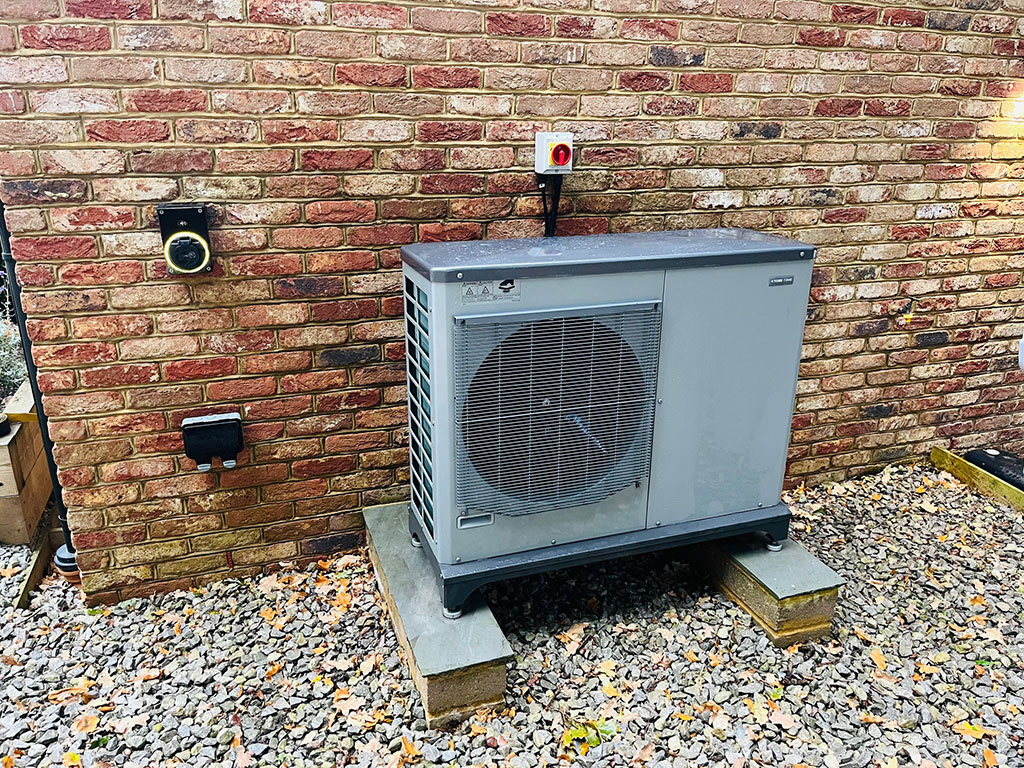
The larger 1920s and 1930s detached and semi-detached houses in South Cheam, Parkside and the roads near Nonsuch Park have the side returns, garages and rear plots an outdoor unit needs. The obstacle here is rarely outdoor space. It is cylinder space in houses that lost the airing cupboard to a loft conversion or a second bathroom, emitter sizing in solid-walled and pebbledashed properties with no cavity to fill, and siting consent in the village.
Getting a van to your door in Cheam
Parking shapes how a job here actually runs. Sutton operates five controlled parking zones and one of them is the Park Lane, Cheam zone, so if you are inside it we would rather you sorted a visitor permit in advance than on the morning of a boiler replacement. Park Lane itself is a narrow historic street with deliberately limited vehicular access, which makes carrying materials to the listed cottages slow going. Parkside is heavily yellow-lined, which is why so many of those 1920s villas paved their front gardens for driveways, and the Jubilee Road terrace has little room in front for off-street parking. In North Cheam we work off a side street rather than the A24 frontage.
Hard water, limescale and how long a system lasts here
Cheam water is hard, and that shows up as scale in heat exchangers, cylinders, shower valves and thermostatic mixers. It is the usual reason a boiler here stops performing well long before it stops working. The hottest, narrowest passages fur up first, so hot water goes lukewarm or swings between hot and cold while the appliance itself still fires. On every installation we look at scale reduction on the mains feed, a system filter, a proper chemical clean and correct inhibitor dosing. On an unvented cylinder in a South Cheam house with two or three bathrooms that is not an optional extra, because the coil is doing all the hot water work with no cistern above it to take the pressure off.
Check the consent before anything goes on an outside wall
The Cheam Village Conservation Area was designated in 1970, takes in about 29 hectares around Park Lane, Malden Road, The Broadway and Park Road, and is covered by a Character Appraisal and Management Plan adopted by Sutton Council, which divides it into sub areas. Whitehall on Malden Road, the Church of St Dunstan and the Lumley Chapel are the Grade II* examples. Work to a listed building can need listed building consent, and that can include internal work, so it gets checked with Sutton before anything starts. Our position is straightforward. A flue terminal, an external condensate run or an outdoor heat pump unit on a front or otherwise prominent elevation in the conservation area gets checked with Sutton's planning team before installation rather than afterwards.
Streets, villages and postcodes we work in around Cheam
The borough boundary runs straight through this part of the map, and the council covering your street is not always the one you would expect. Sutton is the planning authority for most of the town, but land west and south west of Cheam Park falls into Epsom and Ewell, and Banstead is Reigate and Banstead. These are the places we work in around here.
- Cheam Village (SM3) The historic core around Park Lane, Malden Road, The Broadway and Park Road, a conservation area with listed cottages on Malden Road and Park Lane.
- North Cheam (SM3) District centre at the Victoria junction where the A24 meets the A2043. Mostly 1930s semi-detached and terraced housing, with St Anthony's Hospital nearby.
- South Cheam (SM2) Large interwar detached and semi-detached houses on generous plots south of the railway, on roads such as Northey Avenue, Sandy Lane and Cheyham Way.
- East Cheam and Gander Green Lane (SM1) The eastern edge running towards Sutton, in the Sutton West and East Cheam ward. Mixed interwar and postwar houses, with Sutton United's ground on Gander Green Lane.
- Stonecot Hill (SM3) North east of North Cheam on the A24, in Stonecot ward. Interwar and postwar suburban housing on the approach towards the St Helier estate and Morden.
- Parkside (SM3) The 1920s villas built on the former Cheam House grounds, with Arts and Crafts detailing, grouped chimney stacks and heavy yellow lining on the streets.
- Nonsuch Park (KT17) The large historic park immediately west of Cheam Park, straddling the Sutton and Epsom and Ewell boundary and jointly managed by both councils.
- Howell Hill (SM2) A pocket on the Cheam and Ewell boundary that falls in Epsom and Ewell borough rather than Sutton, a good reminder that a postcode does not settle which council applies.
- Belmont (SM2) South east of Cheam beyond St Dunstan's Hill and Belmont Rise on the A217, with its own station and a Sutton controlled parking zone.
- Worcester Park (KT4) North west along the A2043 Cheam Common Road and Central Road. Split between Sutton, Kingston upon Thames and Epsom and Ewell, so the planning authority varies street by street.
- Cuddington (KT4) Between North Cheam and Worcester Park, in Epsom and Ewell borough rather than Sutton. Interwar suburban housing on the Cuddington estate lands, much of it later taken into Nonsuch Park.
- Stoneleigh (KT17) West of Nonsuch Park in Epsom and Ewell borough, with its own station. Classic 1930s speculative suburban semis built out around the railway.
- Ewell (KT17) Immediately west of Cheam across Nonsuch Park, in Epsom and Ewell borough. The A232 Ewell Road runs from the Cheam crossroads straight into it.
- Sutton (SM1) The borough town east along the A232 Cheam Road, with its own town centre controlled parking zone and an Article 4 direction on office to residential conversion.
- Banstead (SM7) South of Cheam beyond Belmont, in Reigate and Banstead borough, reached by the A217 and Brighton Road. Another of our primary local towns.
Why homeowners in Cheam call WTS
- Family-run since 2008, started by William Smith, with our head office at Jayes Park Courtyard in Ockley near Dorking rather than an office miles away in London.
- Gas Safe registered heating engineers, so boiler installation, servicing, repair and landlord gas safety certificates here are all handled in house.
- A 24/7 emergency response for the things that will not wait, such as a burst pipe in a solid-walled village cottage or a boiler down in winter.
- A 12-month warranty on parts and workmanship for everything we install, from a combi in a North Cheam terrace to an unvented cylinder in South Cheam.
- We work for private households, landlords, construction companies and tier-one contractors, so a flat check here and a large mechanical installation both get the same process.
Cheam plumbing and heating questions
Yes, Cheam is one of our main local areas. Our head office is at Jayes Park Courtyard in Ockley, near Dorking, so our engineers come in from the Surrey side. We work in Cheam Village, North Cheam, South Cheam, East Cheam and Gander Green Lane, Stonecot Hill, Belmont, Worcester Park, Cuddington, Stoneleigh, Ewell and Banstead. Call 01306 621 057 to book.
Usually yes, but the incoming main decides it, not the house. Most semis here were built with a feed and expansion cistern and a cold water storage cistern in the loft and a vented cylinder in the airing cupboard, so a combi conversion means decommissioning both and proving the main will carry the flow you want. In a larger South Cheam house with two or three bathrooms, a system boiler with an unvented cylinder is often the better answer.
Sometimes yes. A listed building can need listed building consent for work affecting its character, and in the conservation area anything visible on a front or prominent elevation should be checked with Sutton Council's planning team first. In practice we contact the council's planning service before the job is booked, and we supply what they ask for: a drawing showing the proposed position on the elevation, the dimensions of the unit or terminal, and the finish. We allow for that check in the programme rather than starting and hoping.
Yes, and it is the main thing that shortens a boiler's life here. Scale forms in the hottest, narrowest part of the system first, so a combi's plate heat exchanger furs up and hot water goes lukewarm or swings hot and cold long before the boiler ever faults. On an unvented cylinder in a larger South Cheam house the coil scales instead and recovery slows. A first service on an unprotected system usually turns up a scaled exchanger and black magnetite in the filter.
Wherever you can arrange, and it is worth sorting before the day. A driveway or an off-street space is easiest. If your street sits in a controlled parking zone, a resident or visitor permit is what covers the van during the controlled hours, which is what matters on a full day job such as a boiler replacement. Otherwise there is a public car park at Cheam Library on Church Road. Tell us at booking which of those applies.
Yes. If you let a property here with gas appliances you need an annual landlord gas safety check carried out by a Gas Safe registered engineer, and we do those across Cheam and North Cheam. One extra point for landlords here: Sutton confirmed a borough-wide Article 4 direction on 26 November 2024 removing permitted development rights for converting a dwelling into a house in multiple occupation, and that does apply here.
Book a plumber or heating engineer in Cheam
If you are in Cheam and you need a boiler repaired, replaced or serviced, a leak traced, a drain cleared or an honest answer on whether a heat pump suits your house, call WTS Plumbing & Heating Ltd on 01306 621 057. We are a family-run firm, established in 2008 by William Smith, working from our head office at Ockley near Dorking. Our engineers are Gas Safe registered, we run a 24/7 emergency response, and everything we install carries a 12-month warranty on parts and workmanship. Tell us the road and the age of the house and we will tell you what is likely.
What we do in CheamPlumbing in CheamBoilers and heating in CheamDrainage in CheamHeat pumps in Cheam
Nearby areas we also coverPlumbers and heating engineers in BansteadPlumbers and heating engineers in EpsomPlumbers and heating engineers in Wimbledon